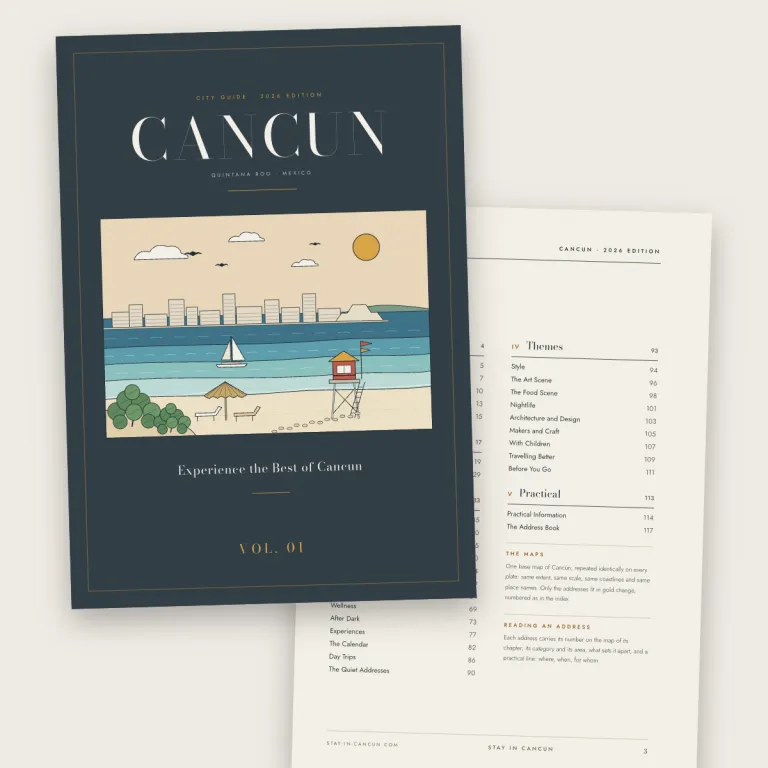
Cancun is a city that was drawn before it was built. In 1969 the Mexican government and the Banco de México chose an almost empty barrier island for a new resort, construction began in 1970, and the plan split the destination in two: a strip of sand shaped like a 7 for the hotels, and a mainland town, El Centro, for the people who would run them. That split still explains where you sleep, where you eat and how long your airport transfer takes. Our 2026 guide to the city is out, and it is built around it.
What is inside
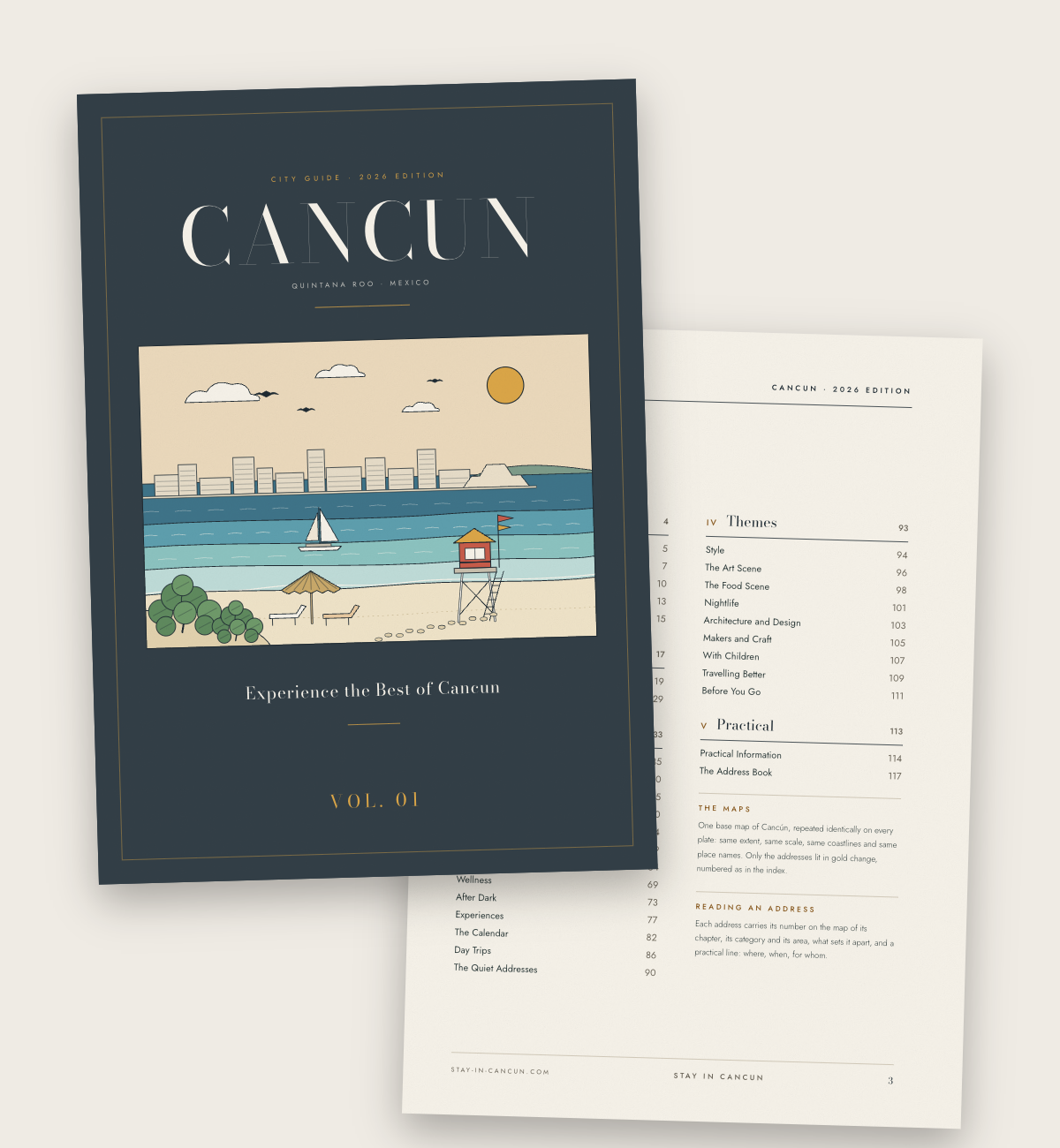
119 plates. 102 numbered addresses, from the only Forbes Travel Guide Five-Star hotel in Cancún to the downtown café where Cancún itself has breakfast. 21 maps. 30 illustrations. Three itineraries. Five parts: the opening, the territory, the address book, the themes, and the practical chapters.
The address book is the heart of it: 10 places to stay, 12 restaurants, 8 bars, 6 addresses for coffee and early hours, 10 shops, 10 entries for culture and heritage, 8 outdoors, 5 for wellness, 6 after dark, 8 experiences, 8 dated events, 6 day trips, and 5 quiet addresses for travelers who already know the Hotel Zone.
Nine areas rather than one strip
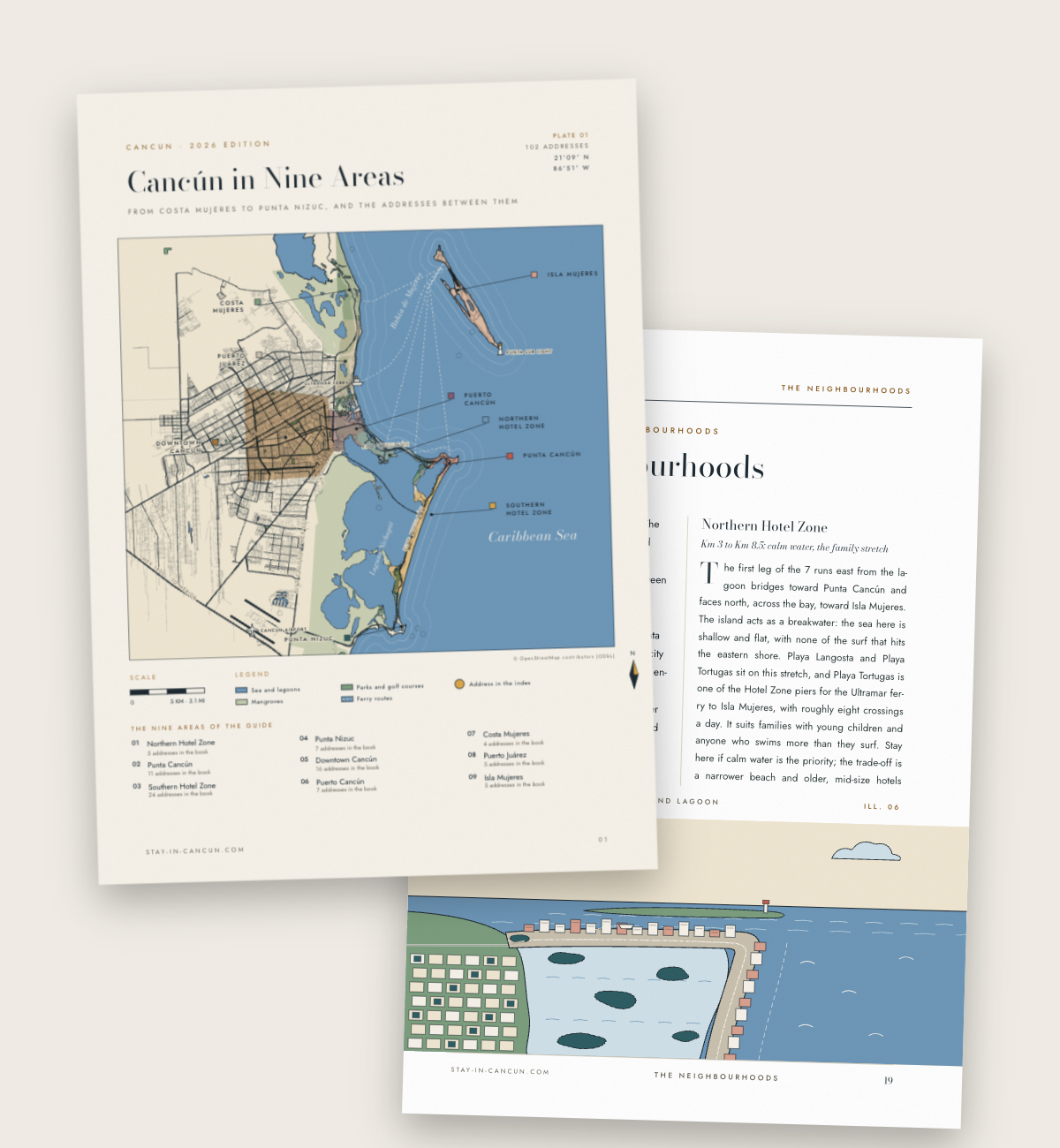
On the Hotel Zone, every address is a kilometre marker on Boulevard Kukulcán, counted from Km 0 near downtown to Punta Nizuc near the airport road, over about 22 km (14 miles) between the Caribbean and the Nichupté Lagoon. The guide cuts the city into nine areas and spreads the addresses across them as they really are: Northern Hotel Zone 5, Punta Cancún 11, Southern Hotel Zone 24, Punta Nizuc 7, Downtown Cancún 16, Puerto Cancún 7, Costa Mujeres 4, Puerto Juárez 5, Isla Mujeres 5. The day trips and the dated events sit beyond them, on the peninsula.
Which stretch you choose decides the water you swim in. The northern leg faces the bay and stays calm and shallow, which suits families with young children; the long eastern side takes the surf. The guide says so area by area, before it names a single hotel.
One base map, 21 times
Every map in the guide is drawn on the same base of Cancún: same extent, same scale, same coastlines, same place names. Only the addresses lit in gold change, numbered as in the index. The first plate shows the nine areas together; each neighbourhood and each chapter of the address book then gets its own plate, so a restaurant, a spa and a beach can be placed against each other at a glance.
Every address says why it is there
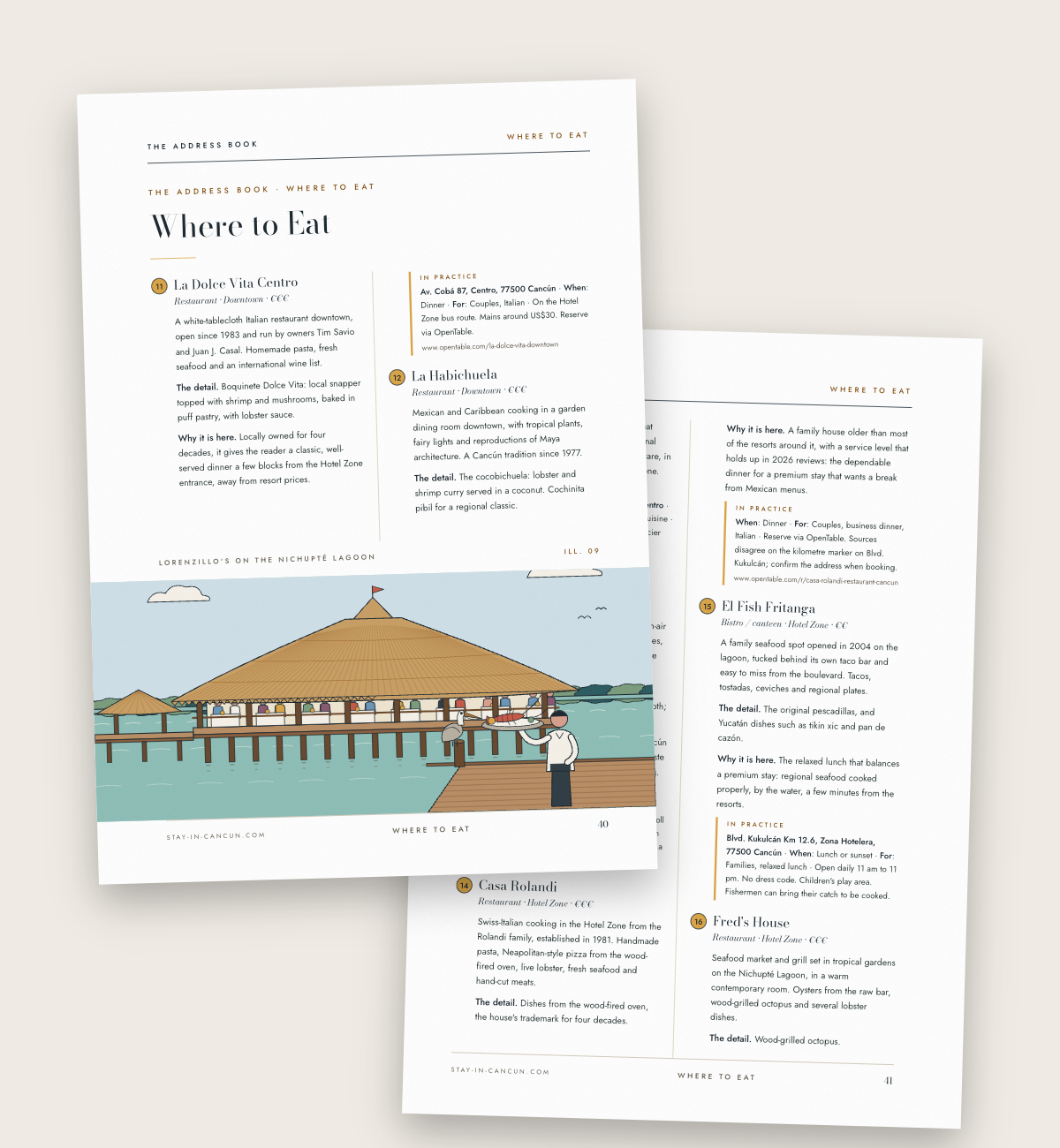
Each entry carries its number on the map of its chapter, its category and its area, a short description, one detail worth knowing, the reason it made the selection, and a practical line: where, when, for whom. La Habichuela is in it because it has been a Cancún tradition since 1977, with its cocobichuela, lobster and shrimp curry served in a coconut. La Dolce Vita Centro is in it because it has been locally owned and open downtown since 1983, a few blocks from the Hotel Zone entrance and away from resort prices.
The same rule holds outside. MUSA, the underwater museum of the national marine park, is listed with its two galleries and their depths, the licensed operators you have to go through and the reef-safe sunscreen required inside the park. The Nichupté mangroves are listed for a guided paddle at first light, far from the jet skis.
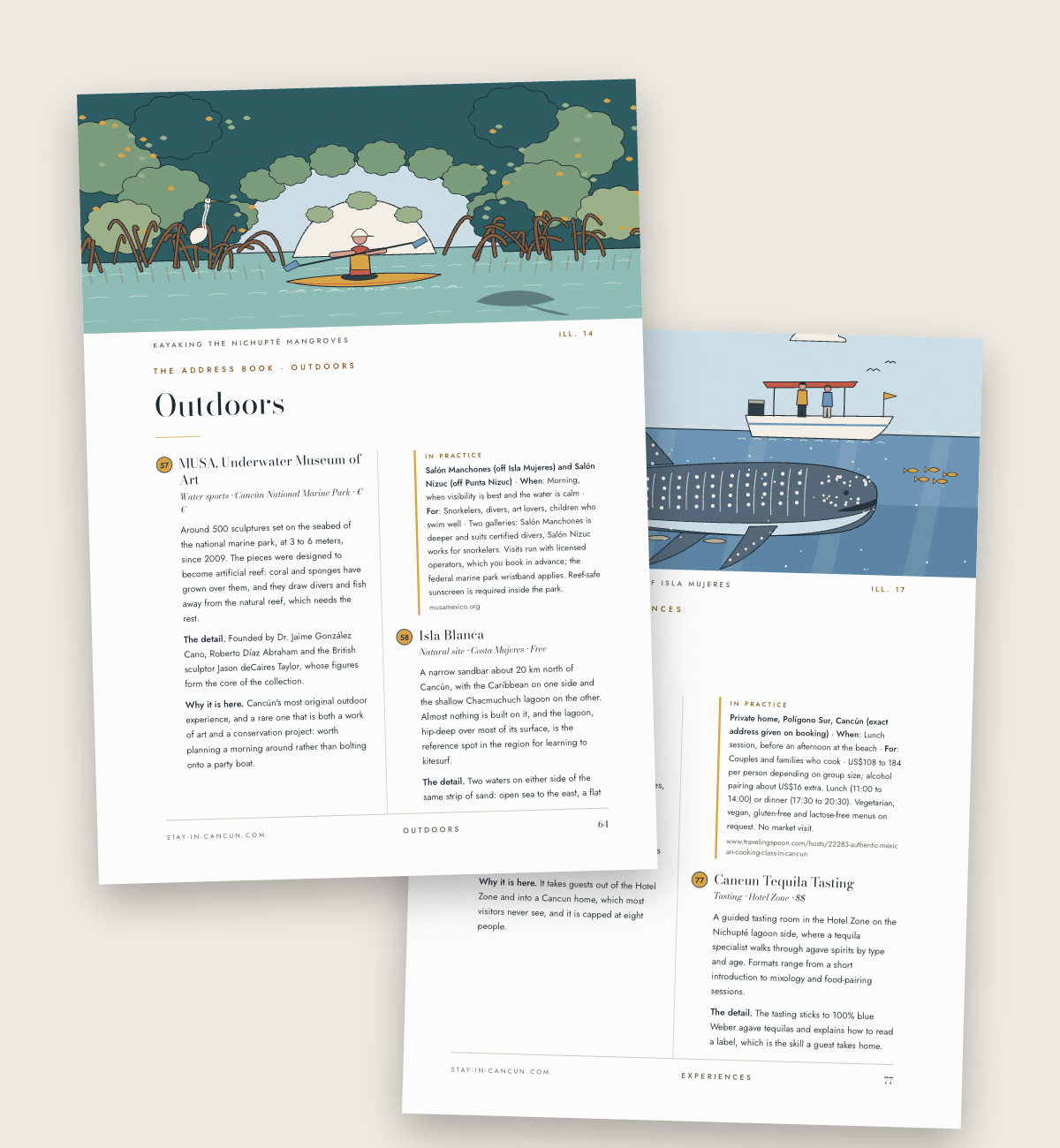
Three itineraries, built only from the addresses in the book
- One Day on the Boulevard, from Playa Delfines at 8 am to the Museo Maya at opening, with taxis or the R-1 and R-2 buses between stops. It does not work on a Monday, when the museum and the San Miguelito ruins are closed.
- Four Days, Island and Mainland: one hotel, no rental car, Thursday to Sunday, because two of its stops keep short weeks.
- Seven Nights, from the Lagoon to the Yucatán, from the most secluded corner of the Hotel Zone to the calm coast north of the city, with one long day inland.
When to go, said plainly
Cancun is warm every month of the year. The guide gives the rest as it is: the winter north winds that can cancel the Isla Contoy crossings between late November and early March, the sargassum that builds from May, a hurricane season that NOAA places at its peak around September 10, and, in return, the lowest average hotel rates of the year in September.
It also covers the local codes a first visit tends to miss. Under article 27 of the Mexican Constitution, the first 20 meters from the high-tide line are federal land: a hotel can reserve its loungers and palapas, not the sand or the sea. And at resort à la carte restaurants, long trousers, a collared shirt and closed shoes are expected in the evening.
How to get it
The guide is free and opens in the browser, with nothing to install: the download is just below this article.